
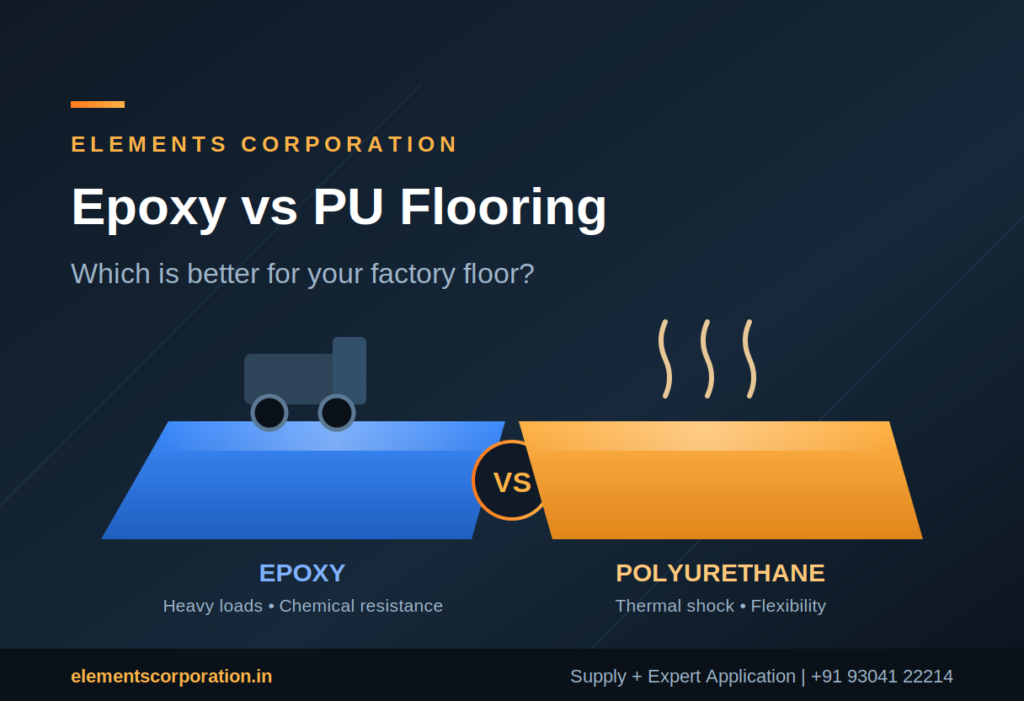
Choosing the wrong floor coating for your factory is an expensive mistake — premature cracking, chemical damage, and production downtime during re-application. The two most common options for Indian industrial floors are epoxy and polyurethane (PU) coatings. Here’s a straight comparison to help you decide, based on what we see every day applying both across plants in Jamshedpur and Eastern India.
Epoxy Flooring: The Industrial Workhorse
Epoxy is a rigid, high-build coating that bonds exceptionally well to concrete. It’s the default choice for most manufacturing environments.
Strengths:
- Compressive strength — handles forklifts, heavy machinery, and point loads without indentation
- Chemical resistance — stands up to oils, coolants, and most industrial chemicals
- Cost-effective — lower per-square-foot cost than PU for comparable thickness
- Seamless and hygienic — easy to clean, no joints for dust and oil to settle in
Limitations: Epoxy is rigid, so it can crack if the substrate moves. It also yellows under direct UV exposure and becomes brittle under thermal shock (frequent hot-water washdowns).
PU Flooring: Built for Flexibility and Thermal Stress
Polyurethane is more elastic and tolerates movement and temperature swings far better.
Strengths:
- Thermal shock resistance — ideal where hot spillage or steam cleaning is routine
- Flexibility — absorbs substrate movement and vibration without cracking
- UV stability — doesn’t yellow, suitable for areas with sunlight exposure
- Abrasion resistance — performs well under constant wheeled traffic
Limitations: Higher cost, shorter working time during application (needs experienced applicators), and slightly lower compressive strength than epoxy.
Quick Decision Guide
- Machine shops, warehouses, assembly lines → Epoxy
- Food processing, areas with hot washdowns → PU
- Heavy static loads (presses, storage racks) → Epoxy
- Mezzanines or floors with vibration/movement → PU
- Chemical storage and battery rooms → Epoxy (chemical-resistant grade)
- Outdoor or sunlit areas → PU
Many plants actually need both — epoxy in production bays and PU in thermal-stress zones. A site inspection settles it quickly.
Why Application Quality Matters More Than the Product
Here’s the truth most suppliers won’t tell you: 80% of floor coating failures are application failures, not product failures. Poor surface preparation, wrong primer, moisture in the slab, or incorrect film thickness will ruin even the best coating.
At Elements Corporation, we supply and apply. Our Chembond-backed epoxy and PU systems come with on-site inspection, proper surface preparation (diamond grinding, moisture testing), and trained applicators — so your floor performs for years, not months.